Saturday, July 26, 2008

What I Love About Print

10 July 2008, Thursday

Small tremor last night at about 9:45 PM. Enough to shake the bed. Not enough to cause any damage. Felt sort of like a huge semi-tractor trailer went by. But of course, that's not possible here. Sat up in bed and my first thought was—but Africa is such a stable continent geologically speaking, it's not supposed to have earthquakes.

Eileen went to the homes of several nurses—Brenda, Monica, Nyayele and Emma—to photograph them while I interviewed Prospeline Chipata, who works in one of the farthest of the health centers that Embangweni supports. She was very shy and I fear that the interview didn't come off all that well. A little like pulling teeth to get her to talk. And of course, she was speaking in English, which is at least a second or third language.

But she's been working in that village for eight years. Unmarried. (Not surprising how many women I have interviewed who are not married or whose children had already grown by the time they came to Embangweni.)

In the middle of the interview, I learned that Prospeline has been trying to get the government to provide free bed nets for people with HIV. When I asked how that was going, she indicated it might take a while—she didn't know. Have noticed this kind of sad fatalism before whenever talk of future plans or potential government help comes up.

Also asked Prospeline to describe one or two patients whom she knows she has helped and felt good about. Her eyes lit up with a quiet pride as she recounted the story of a pregnant woman she had examined, who it turned out was carrying twins. Prospeline was able to refer the woman to Mzimbe District Hospital right away and the woman was successfully delivered of her twins. So the fact that all three are alive and well is more than likely due to Prospeline's actions.

This is what I love about print. You can take someone like Prospeline and make a story out of her—give her more of a voice, even if she doesn't sound that confident on the recording. I managed to take a decent photo of her in the small room off the chapel. A happy accident—using light through the door that bounced off a mostly white wall.
Eileen has taught me to open doors to get more light from outside. And to separate the background from the foreground in portraits. So I had Prospeline sit in the chair a little further away from the wall. Very nice portrait.

Classes in HIV and Photography

9 July, Wednesday

This morning attended a two-hour class on HIV/AIDS and ARVs, given by Getrude (that's how she spells it)—in the local language, Tumbuku. A few giggles when she whipped out a wooden phallus to demonstrate how to put on a condom. But the class was very attentive and interacted well.

In the afternoon, I interviewed Brenda Ngoma and Monica Mwale of the ARV clinic. Plus got another antenatal women's group to sing what I'm starting to think of as the prenatal song. Will have to get someone to translate it for me.

Monica said that the oldest person they have put on ARVs so far is 65 or so, the youngest was 1 year and nine months. I noticed Ellie Click's name and cell phone (doctor from Baylor Pediatric AIDS clinic in Lilongwe) on the wall and ask Monica about it. Monica says Ellie came to Embangweni for four days and has been in touch since. Whenever Monica has a question about children and AIDS drugs that she can't answer, she calls up Ellie.

Other notable things from this morning:
1. Flip chart to teach about AIDS with a kind of stylized warrior with a shield no longer being able to defend against the arrows from smaller red bad guys. ARVs are like the army or police. They put handcuffs on the bad guys but they don't kill them (to make the point about suppression not cure.)

2. They make the point that people with HIV should sleep under bed nets to prevent malaria. But although the ARVs are free, the bed nets for HIV patients are not. Only pregnant women's and kids under age of five are eligible for free bed nets—and there's even some question about whether kids under age 5 are still eligible for the government program.

Monica travels by bicycle 8 km every day to and from home to the hospital. Eileen is teaching me how to pan a shot of Monica on the bike so that the background blurs but Monica and the bike are in focus.

(NB: This post was written on site in rural northern Malawi and posted now that I again have internet access.)

A Mother of Nine with Eight Different Fathers

8 July, Tuesday

Drove up to Ekwendeni with Billy in the driver's seat and a few other passengers in one of the older vehicles. Smaller dirt road than the one to Jenda, then tarmac up to Mzuzu and Ekwendeni.

Great interview with Mphatso Nguluwe, deputy principal at the College of Nursing in Ekwendeni. Just listened to a bit of the audio (which I backed up on the firewire drive). Good quality sound and everything. Also tagged along as she supervised a couple of student nurses in the hospital.

Just before we left, caught up with Esau Kasonda, a Malawian nurse who wrote an essay that was published on time.com. He's now teaching at the College of Nursing at Ekwendeni.

Mphatso talked about many things but two I want to remember most. The first is that she is, as she says, "the mother of nine children by eight different fathers" and the second is that she feels like she needs a break from teaching. She is getting frustrating it seems with the quality of the current crop of students.

What she means by saying she is the mother of nine kids by eight different fathers is that she is raising nine children. She actually has never given birth to a child herself. Was engaged to be married once but her fiancĂ© died in 2002—in South Africa. She talked briefly of grief and then wondered whether, had he lived, he would have allowed her to take care of so many children?

I also learned Mphatso likes to tell church groups and gatherings that she is the mother of nine with eight different fathers. And then when she hears a gasp or murmurs of disapproval she likes to say, "What? Aren't we in church? I thought I would not be judged in church."

What you might call a teachable moment.

We stopped at an internet café to update blog. After 45 minutes, nothing went through. Tried twice on Gmail and kept getting server errors. Not sure why. Wonder if Yahoo would have been simpler? Seems to be what everyone else is using.

Thoughts on Expiration Dates and Acute vs Preventive Care

Matron Catherine Mzembe examines expired surgical gloves that have been donated to Embangweni Mission Hospital in Malawi

7 July, Monday

Quiet day today. Several people are off for Malawi's Independence Day celebration. Mrs. Kamanga and Matron Catherine Mzembe spent much of the morning opening and sorting cartons of donations from overseas. One box contained sterile surgical gloves, which was cause for some celebration until Catherine saw that they had expired in 2006 (see photo above).

A shadow quickly crossed her face. They will be able to use them as examination gloves but certainly not as surgical gloves. There isn't one expiration date for the U.K. and another for Malawi, she said in exasperation. Why would anyone send something that they would not use themselves?

Good news this afternoon. The baby with "congenital herpes" actually has chicken pox. Already she is doing much better and probably will be discharged soon.

A happy ending but it brings up a more disturbing issue: in trying to help, the volunteers from Massachusetts actually made things worse—bringing a child with a highly contagious infection into a hospital where many people have very weak immune systems.

After talking with Joyce and some of the other community health nurses here, I have learned something else about mobile clinics in rural Malawi. They work best for doing preventive care: checking expectant mothers to see how their pregnancy is developing, screening for high blood pressure, vaccinating children, educating the wider community about the need to refer someone with a chronic cough to the hospital—that sort of thing.

If you structure your mobile clinic to deliver what is known as acute care—treating someone with an infection, for example—you actually end up making things worse. (And the Embangweni staff should know—they tried giving acute care during mobile clinics before.) Antibiotics that are given out will be shared among family and friends—leading to drug resistance. Plus you are conditioning people to wait for the mobile if they have a major problem—like a headache that hasn't gone away for three days—instead of going to a health center or hospital right away.

Prevention and acute care have to work hand in hand. What's the point of screening pregnant women in the community, for example, if you don't have a hospital to send them to deal whenever you identify a problem? And similarly, what's the point of curing hundreds of children of malaria or diarrhea if you can't work with the community on mosquito control (making sure banana trees, which harbor lots of mosquitoes, are located away from the house, using bednets), clean water and basic sanitation?

(NB: This post was written on site in rural northern Malawi and posted now that I again have internet access.)

A New Head of Clinical Staff at Embangweni

5 July, Saturday

Albert Nyirongo, a seasoned clinical officer, arrived this afternoon. He is taking on the responsibilities of the medical officer in charge and is on permanent loan from Ekwendeni near Mzuzu. That has eased the clinical-officer crisis somewhat for Embangweni.

I caught up on notes and logging audio. Talked with some of the other guests at the guesthouse. Hannah and Marie are two medical students from England who are here for a few weeks as part of their tropical medicine course.

Today's the last day for the medical volunteers from Massachusetts. They went out on a mobile clinic and brought back a two-week old baby with a rash from head to toe.

Diagnosis: congenital herpes. Treatment: intravenous acyclovir, something Embangweni hospital doesn't have. Prognosis: not good. The child is likely to die, they said.

Thought Eileen and I might go to the market this afternoon but I felt a touch of unsettled stomach and didn't want to risk it. Took a nap instead.

Not sure if it was the heat or what but the feeling went away. Never got sick. Indeed, haven't been sick yet this whole trip—knock wood. Have eaten a heck of a lot of starch—bread, pasta, potatoes and even nsima—loads of chicken and some delicious cooked mustard greens and even pumpkin leaves, but no fresh greens. Also been scrupulous about hand-washing and using hand sanitizer—before brushing teeth, before eating meals, after going to bathroom, after touching shoes, after returning from hospital.

(NB: This post was written on site in rural northern Malawi and posted now that I again have internet access.)

Mobile Clinic Plus an Odd Comment

4 July 2008, Friday

Happy U.S. Independence Day! Independence Day in Malawi is on Monday, July 7. It's actually July 6 but since that falls on a Sunday, the country is celebrating it on Monday.
Early morning wake-up at 5:15 AM so that we could catch Hilda before she went off shift. Eileen got quite a few photos before it was time to head for breakfast.

Skipped chapel in order to get ready for the mobile clinic with Joyce Ngoma. Left at 9:05 PM. Stopped first at the market in Embangweni to get some supplies. And then drove a good 45 minutes on bumpy dusty roads to Mhalaunda Health Center, where we took on more supplies and a couple more people.

Our final destination was Emazwini—more than 30 kilometers from Embangweni by dirt road. Have a feeling it's closer as the crow flies but then crows don't deliver medicine or examine pregnant women to make sure they're doing okay.

Already many people lined up in different areas under the trees. One section for weighing babies, followed by the delivery of World Food Program soya flour and palm oil. The women stretched a cloth out on the ground, a bucketful of meal was placed in a heap on the cloth and then a large cup full of oil was poured into the center of the meal, everything then wrapped up and carried home that way.

Learned that Joyce did three years training as an enrolled nurse. Spent a lot of time on the maternity ward "catching babies," then did a year's training at the Malawi College of Health Sciences to be a public health nurse.

She has now served as a public health nurse for 10 years. Says that's the only way to find out what people's health is really about—to see for yourself if their water is bad. What conditions in the home are. She also works with the agriculture agents in the area about what is nutritional food. She trained the community health volunteers—and introduced us to them. "They are our eyes and ears and feet and hands," she says.

Depending on which tree you sat under you either got your babies weighed, blood pressure checked, arm circumference measured or soya meal allocated.

Vaccinations happened in one room of medium-sized building. Prenatal checks in another room with two windows. That's where Joyce spent most of her time—and so where Eileen and I stationed ourselves as well. Thankfully out of about 25 or 26 pregnant women, there was only one complication: a woman had had a previous caesarean section and was over due. She will be heading to the hospital tomorrow.

Eileen got some great photographs. One of my favorites was of Joyce listening for fetal heart sounds with an old-style inflexible metal stethoscope. Reminded me of the old movies in which people put a glass to the wall in order to eavesdrop on a conversation in the next room.

Then came the contraceptive clinic. Fewer women were there but nonetheless, they were there. Most apparently got Depo-Provera injections (you get it in the buttocks—who knew?) I later learned that women in this area seem pretty open to contraception after having five children. They also use contraception to time their births so that they won't have a one year old and a newborn at the same time. Usually that means the older child can't get enough to eat because the mother's milk goes for the newborn.
Lunch was about 2:00 PM at the local headmaster's home. Ate rice, cooked mustard greens and a bit of beef. (And, just to satisfy the curious, experienced no ill effects.) Then another bumpy 30-plus-kilometer ride in the back of the ambulance to Embangweni. Bet I sleep well tonight.

An Odd Comment

There's a church group from Massachusetts staying at the Guest House that includes a doctor, a nurse and a paramedic. They're here with World Relief and have brought a lot of medication with them—including amoxicillin, antacids and Bactrim. The physician excitedly told me they were going to an area where no one had ever seen a doctor before. So naturally I asked where and learned they were going to the Mhalaunda Clinic.

My first thought was, well do they really need to see a doctor from Massachusetts? But figured I was just making polite conversation and didn't want to be rude. Besides, I liked the woman. And yet, her comment stayed with me—although I didn't at first realize why. (Sometimes I'm a little slow on the uptake.)

Later realized what it was that bothered me. They were going to a permanent health center that is staffed by a nurse. The clinic is one of four health centers in the Embangweni health system. Patients are referred to the hospital by the nurse. So they do have access to care—whether or not they have seen a physician at the clinic. And in fact, Mhalaunda is one of the closest health centers to the hospital.

(NB: This post was written on site in rural northern Malawi and posted now that I again have internet access.)

Success Creates Its Own Problems

3 July 2008, Thursday

Morning report at about 8:40 PM. Tagged along with Catherine Ndolo again. Watched her prepare the operating theatre for an endoscopy. Getting the equipment ready, making sure there was sterile gauze available. The whole room illuminated by natural light. Really quite amazing. There are fluorescent lights overhead and a round surgical lamp. The clock on the wall is stuck at ten past five and hasn't moved since I've been here.

The patient is a Mrs. Jere (a very common last name), who has been complaining of pain after eating for the past year. She has been to the district hospital at Kasungu but they keep sending her away. She decided to get herself to Embangweni to see if they could get to the bottom of things. In other words, she preferred going to a hospital in a rural area, which is at the end of a 45-minute ride on a dirt road, rather than to a nearby hospital on a tarmac road.

In fact, another woman who came in on Monday had an ectopic pregnancy, which was missed at Kasungu Hospital. They performed an ultrasound and said that the pregnancy was proceeding normally. She referred herself to Embangweni, where the ectopic pregnancy was diagnosed and taken care of.

These self-referrals from outside Embangweni's catchment area have placed a major strain on the hospital. Because of course by the time people get here after having been at another hospital, they are in much worse shape and require a great deal more attention and effort to save their lives.

The past four months have been particularly bad due to a critical lack of clinical officers. Apparently, many hospitals have been offering top-ups to clinical officers on their own authority—not as a matter of Ministry of Health policy but as a matter of survival—and so they are getting poached out of the rural areas. One clinical officer who was supposed to come yesterday during his month leave to help bail out Embangweni was forbidden to do so by his home hospital when they found out. He has told to help them out instead.
The nursing shortage continues to be chronic but at this moment, the lack of clinical officers is the crisis.

Yesterday's Malawi Daily Times had an article about a new team of doctors who have just arrived from the People's Republic of China and will be headed to the central hospitals in Lilongwe (where I had visited the pediatric ward) and Mzuzu.

Previously the Mzuzu Central Hospital had been staffed by doctors from Taiwan. But when Malawi switched diplomatic status from Taiwan to the People's Republic, the Taiwanese doctors left and the Taiwanese programs were suspended. I've heard from a couple of people the doctors at Mzuzu were given 48 hours to leave—although it's not clear by whom.

And ever since then the Mzuzu hospital—one of only a handful of central hospitals in the country and perhaps the only central hospital the north (I'm not clear on this)—was basically non-functional. In any event, it's the central hospital to which Embangweni ultimately refers (after the district hospital in Mzimbe).

Here's what The Daily Times article had to say:

Chinese ambassador to Malawi Lin Songtian said the team would be in the country for six months but said another team would arrive after agreements and documents were signed between the two countries.

The ambassador said that on a recent visit to Mzuzu Central Hospital, he found deplorable conditions, especially in the maternity wing so he requested his government to send over a team before agreements were finalized.

"Mzuzu was our first priority because as you know, our brother Taiwan had a team there helping out so when they left, people were left destitute," he said.

(NB: This post was written on site in rural northern Malawi and posted now that I again have internet access.)

Show Us That You Care

2 July 2008, Wednesday

After chapel we joined Catherine Ndolo, a nurse midwife technician who is rotating through the operating theatre. Wednesday morning is the time for scrubbing down the OR from top to bottom. (They also do it after every procedure.) I think Catherine was a little surprised that we wanted to go into the operating room to document the scrubbing but we assured her that's what we wanted to do and so suited up in gowns and rubber clogs. And from 9 AM to 10:30 AM, Eileen took photographs and I recorded the sounds of the scrubbing, mopping, splashing of water, etc.

After lunch I recorded the audio interview with Catherine Ndolo. She seemed rather shy but she has quite a story to tell. After being a nurse for a while in various urban settings, she came to the Embangweni area to care for her ailing father. And then when she wouldn't leave him, he said she'd better get a job at the hospital. She saw what good care they took of her father in his last days, so felt very grateful and continued even after he died. Then later, when some U.S. friends raised money so she could go to San Francisco to get a carotid tumor removed from the left side of her neck, she figured she had better stay with the hospital. So she's been here for 14 years.

There are drawbacks, of course. Transportation is a big issue and food. It used to cost 50 kwachas to get to Jenda on the dirt road, Ndolo says. Now it's 700 kwachas. By comparison, the whole trip from Jenda to Lilongwe on the tarmac road is 700 kwachas, she said.

Alas, I made a mistake in downloading the audio file and didn't double-check to make sure I had actually backed it up before I erased it from the card. And so will have to do that interview over again. Also, I realized I should try to get a quieter room next time. That could be a bit of a problem around here. Always everywhere, somebody is talking and the sound carries through all the open windows.

Am struck by the sense that Ndolo stays because this is a place that cares for her as a person. How do you put that sense of caring for people—for patients as well as staff—into a strategic plan? The message was pretty clear when I saw that miniscule bar of soap at Kamuzu Central that somebody didn't care what the nurses had to wash with—either there wasn't much soap to begin with or staffers were stealing it.

Of course, not everyone will feel obliged to repay a debt of gratitude. Catherine Mzembe, who is head of nursing or matron at Embangweni Hospital told me the story of three male staffers who were sponsored by the hospital for further education and left before completing their bond—basically an agreement to work for several years after advanced training—and two female nurses who left—one to get married and the other who was hired away by an NGO, which paid for her bond.

Evelyn Chilemba and Diana Jere at the Kamuzu College of Nursing told me two weeks ago they had re-introduced a requirement that all nursing student candidates be interviewed in person as well as pass an entrance exam because they wanted to weed out those who saw nursing as just another paycheck.
And of course, there is a prisoner's dilemma aspect to all of this. You can be the most caring person in the world, but if enough people around—and above you—don't care, then for your own survival you probably should stop caring as well. Otherwise, everyone around you will just take advantage of your compassion. But that just makes a bad situation worse.

(NB: This post was written on site in rural northern Malawi and posted now that I again have internet access.)

First impressions of Embangweni


1 July, 2008, Monday

Where to begin? Chapel had already begun by the time we arrived at 7:05 AM. Mostly in Tumbuku. Some scripture reading, some extemporaneous exegesis by the sounds of it, a choral selection, sharing of concerns, announcements, a hymn and a benediction.

The Embangweni Mission hospital compound consists of several dozen terracotta-brick buildings and outer buildings surrounded by a terracotta-brick wall. Although the staff have told the community they need to keep the chickens out, there always seem to be a few hens clucking about on the grounds.

Officially, the catchment area is 100,000 people. Unofficially it's closer to 150,000.

Currently, Embangweni has about 130 beds plus mats for about 60 expectant mothers. Each inpatient, however, is typically accompanied by at least one and often two or three relatives. On average, the hospital has about 4500 to 5000 inpatient admissions each year and three times as many outpatient visits. That's not counting all the folks seen by the health centers and the mobile clinics.

Being admitted to a hospital alone is practically unheard of. For one thing, there is no facility to serve meals, so relatives bring food and water (there is a bore hole on the compound). Nurses hand over pills to each patient's caregiver or guardian and watch as the medicine is swallowed with water drawn by the caregiver. As odd as the system seems, it works. Given the personnel shortage, it would be criminal to try to keep friends and relatives out.

Its hospital policy to let one guardian sleep on the floor next to each patient. Others sleep outside the compound in the guardian shelter. Moms sleep with their children in the beds on the pediatric ward. Children six and up are admitted to the adult wards—which isn't ideal and the Embangweni staff know it. There are plans for a new ward for kids 6-to-13 years old—provided funding comes through, etc.

There are four main wards--female ward, male ward, pediatric ward and maternity—and the operating theater which is centrally located. At first glance, the wards seem practically deserted. In fact, everyone—family, friends and patients—are outside on the grounds, enjoying the winter sun. Only the very sickest remain inside.

In total, there are about 200 staff members employed by the hospital, including maintenance crews, laundry teams, drivers, ward maids, data clerks, the accounting team, nurses, clinical officers (sort of like physicians assistants or nurse practitioners), one physician, one matron and one hospital administrator.

Embangweni is a mission hospital—part of the Church Health Association of Malawi, which provides about 40% of Malawi's health care. There is one missionary here from the U.S.—Martha Sommers, who is a family physician—but she is not in charge. That is the job of the medical officer in charge. Right now Smith Mpepo, a clinical officer, is the acting officer in charge. The hospital is hoping a more permanent medical officer in charge will be arriving soon.

As for the rest, Mrs. Kamanga is the hospital administrator. She seems quite formidable—which is important when you're trying to prise amoxicillin or other drugs out of the government's Central Medical Stores. But she also has a wonderful laugh and a generous heart.

Am struck by the enormous size of the trees all around the compound. Some are 80-to-100 feet tall and look for all the world like the live oaks around the Rice campus in Houston. Several 10-to12 foot tall red and white poinsettias here and there and some enormous bougainvillea. Mango trees line several alleys. Not the sort of thing I had expected to see. But speaks to the generations of women and men that have invested in this place. Begun as a dispensary in 1902. Became a rural hospital in 1926.
Reminded me of something I heard from Leon Kintaudi, who was named one of TIME's Global Health heroes in 2005. We were talking about time frames—five-year programs and the like. He argued for a much longer horizon. You have to do things now in order to make a difference 100 years from now, he said.

(NB: This post was written on site in rural northern Malawi and posted now that I again have internet access.)


Arrival in Embangweni

29 June, Sunday


The driver from Embangweni showed up half an hour early—at 8:30 AM. Fortunately, I was packed. Eileen was almost ready but it threw us both a little into a tizzy. Anyway, we got everything in the cab of a Toyota pickup. There was room for four (including the driver, Wezi, which means Grace and is a name used by both men and women) and we picked up the hospital secretary and her 14-month old for the trip back.

Wezi had clearly planned to get diesel in Kasungu but when we got to the BP filling station, there was no diesel to be had. No diesel in either of the other two filling stations in town either. Red cans were placed in the lanes to show they were out.

About 5 minutes further north along the M1 we understood why. The diesel delivery truck was pulled over to the side of the road and the driver was changing a tire. Wezi's body language changed a bit after that. He said we didn't have enough diesel to get all the way to Embangweni. But not to worry, if we got stuck, they could send some diesel out from the mission station (still about an hour and a half away) to bale us out.

And so we went on a diesel hunt, stopping at every little local market along the way. Wezi asked various merchants and mechanics where we might buy some diesel. Various suggestions. But none could be had.

We kept driving. Not sure why I was so calm. Guess I realized it was completely out of my hands. Was already thinking I was glad I had an umbrella against the sun—in case we got stuck on the side of the road.

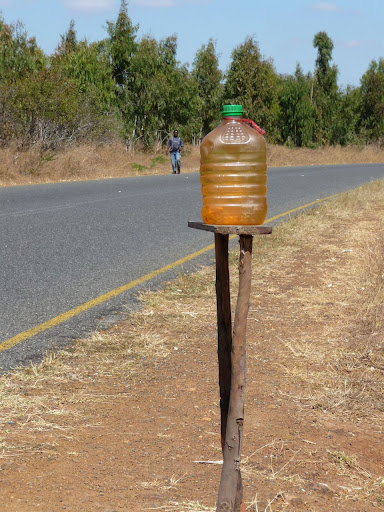
Suddenly, Wezi slowed down. There was a bottle of orange liquid in a large translucent container propped up on a stand by the side of the road. Clearly it was for sale. (Snapped a photo.) Wezi stopped to find out if it was petrol or diesel (petrol being gasoline). Turned out it was petrol. So we kept driving.


Finally at the next market, Wezi stopped at a mechanic's shack and asked about diesel. Although the mechanic didn't have any, he obligingly phoned ahead on his cell and determined another local entrepreneur was selling it by the side of the road further north.

But, as Wezi told us later, the feeling was the diesel guy might not want to sell to us because what he was doing wasn't strictly legal and he might feel like we would rat him out to the police. So the mechanic counseled Wezi to speak in Tumbuka (instead of Chichewa) and plead with him that we were going to run out if we didn't get any diesel and wouldn't dream of reporting him.

And so that's how we bought about 20 liters of diesel, scooped out of a big old open drum. I now know that diesel is clear and not orangy in color. We paid 6000 kwachas for it—which is probably at least 50 kwachas more than the rate in Lilongwe—but hey, we didn't have to wait by the side of the road to be rescued.

Was told later that the diesel we bought originated with the "broken down" diesel truck. It's also quite possible that several of the filling stations where we had stopped did in fact have fuel but weren't selling any because everyone is anticipating that prices will jump at least another 25% very soon. (They've already gone up 25% since I arrived.)

Arrived at the Jenda road block (can't miss it) and took the first left. Spent about 45 minutes on a fairly bumpy dirt road and then came to the Donald Fraser Guest House. Found our room—basic with two single beds, warm blankets, clean sheets, blue mosquito nets, a flush toilet and shower. First screens on windows I've seen anywhere in Malawi. Much nicer than I had expected.

Made friends with a group of girls (mostly 12 years old) and one younger brother who came by. I took a tour around the compound with the kids while Eileen rested her knee a bit.

Picked up a few phrases of Tumbuku, the language of northern Malawi. "Muli uli" is "how are you," to which you reply "nili makola kwalimwe" ("I'm fine and how are you?") and so on. My young guide, Mercy (very soft r so it almost comes out Macy), was happy to teach me several phrases and wrote them out very carefully in my notebook with the English equivalents next to each one.

Learned from the other guests what the routine was for meals, etc. Will head over to the hospital tomorrow to see Mrs. Kamanga (the hospital administrator), Catherine Mzembe (Matron or head of nursing) and the rest of the staff.

Now to bed after a wonderful day with just enough adventure to make it interesting but not too much so to make it worrisome.

(NB: This post was written a month ago in rural northern Malawi and posted now that I again have internet access.)